Implications of a Matzah Shortage
Many in Israel encountered a matzah shortage on Pesach. “There’s no matzah in the supermarket.” “Does anyone have extra matzah?” “I checked every branch and couldn’t find any.” These messages and more spread through large numbers of WhatsApp groups. In some neighborhoods they even opened dedicated groups specifically for people giving away or looking for matzah. According to all the surveys, the people of Israel, especially the younger generation, are returning to their identity, and so it seems that this Pesach was observed more than ever.
Hearing about the matzah shortage, acclaimed Israeli writer Racheli Moskowitz wrote the following:
“I was happy to hear about all this searching for matzah. It shows that we are not giving up on tradition, and in so many homes people want to feel that connection. It made me think about the hostages who refused to eat chametz on Pesach while in captivity; about Agam Berger, who made it clear to the terrorists that she would not touch pita for an entire week, and how she and her friends recreated a Haggadah from memory. That spiritual heroism surely leaves a mark on the world and ripples outward.
“A year ago, we left an empty chair at the Seder table, waiting for the hostages. This was the first Seder after they emerged from darkness into light. Together with them, we have all received another layer in the story of our national freedom. Have we paused enough to give thanks, to reflect? We are in the midst of a deep national reckoning: Who are we? Why are we here, and where do we belong?
“So yes, there may be a shortage of matzah in the stores, but among us there is no shortage of identity or belonging, and that is the sweetest freedom of all.”
Happy Birthday, Bar
I saw what Racheli wrote come alive on Chol Hamo’ed Pesach. Like so many others, we went to the Old City. Since the Kotel was closed due to the security situation, we simply looked toward the empty Kotel plaza and prayed from a distance. On the way out, in the square at the center of the Jewish Quarter, I saw a birthday celebration, with people lifting someone onto their shoulders. It looked from afar like a noisy American bar mitzvah, and I tried to make my way around the circle of dancers. But then I recognized the birthday boy: released captive Bar Kuperstein.
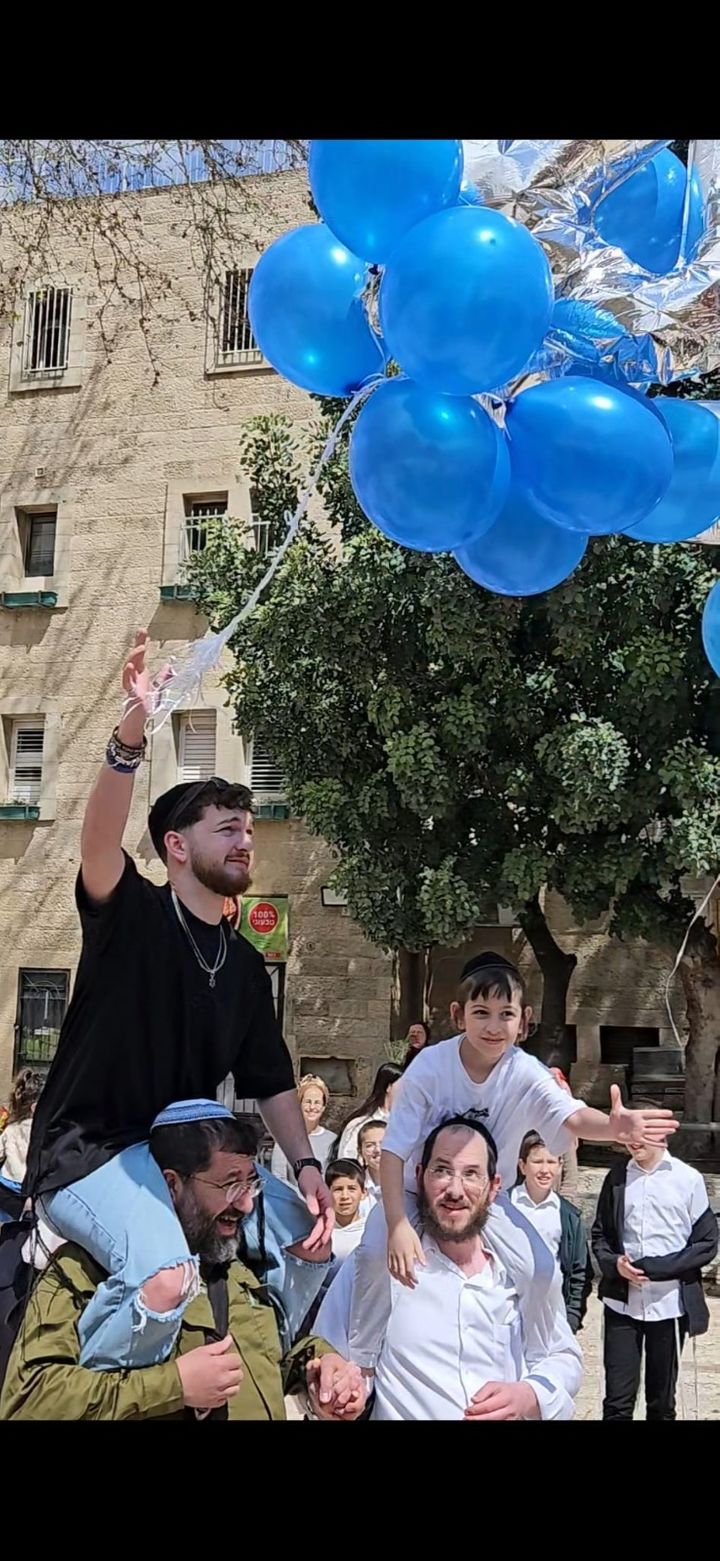
Birthday celebration for released captive Bar Kuperstein
In that very square, Bar’s mother, Julie, had marked his twenty-second and twenty-third birthdays, with prayers, while he was deep inside a tunnel in Gaza. And now she was celebrating his twenty-fourth birthday there with him. Friends and family were there, and of course his father, Tal, who has become a symbol of perseverance and arrived in a specially adapted vehicle with his wheelchair.
The children of the Jewish Quarter brought out refreshments from their homes. Many passersby stopped to hug them, take pictures, offer blessings, and even join the group photo, as if they were family. And really, they were.
Julie summed it up: “It is unbelievable where Bar was on the previous Festival of Freedom, and how he is celebrating this one, which is also his Hebrew birthday. May we merit to see all our hopes fulfilled before our eyes like this.”
Typing Hope with His Nose
Chaim Elchanan Idan lives with cerebral palsy. He cannot walk, eat, or speak on his own. A few years ago, when he tried typing on a computer as usual, he felt once again that his fingers weren't responding quickly enough. His nose, on the other hand, tapped out letters in rapid succession.
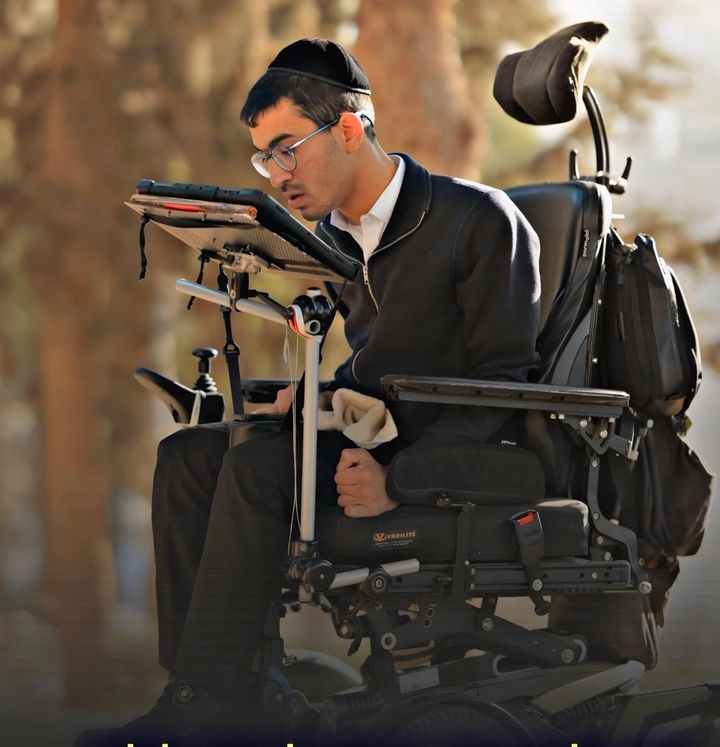
Chaim Elchanan Idan
"Right now I'm typing to you with my nose," he wrote when I reached out to him on WhatsApp. Then he sent me his weekly newsletter on the Torah portion, called Ohr HaTorah ("The Light of the Torah"), which he began publishing back in seventh grade. He sends the texts and printing instructions to the print shop himself, and also distributes the newsletters through the streets of Jerusalem in his motorized wheelchair, dropping them off at shul. "I have to stay busy," he explained, "otherwise I get depressed.”
Throughout Pesach, the Kotel plaza was nearly empty because of the war; only 50 people were permitted to enter at one time, and Chaim was one of them. He wrote: "Thank you for the special privilege of being your messenger and praying here. My advice to everyone is to pray, to speak with Hashem always —not only from the siddur, not only in Hebrew, but even in your own words. I speak with Him a lot, and I highly recommend it. He is there, He is listening. And you don't need to type to Him with your nose…”
Bar Mizvah in Israel, No Matter What
Ahuva Schorr is a party planner living here in Israel. She wrote to me that all her events from March through June had been canceled, with the exception of one: the bar mitzvah of Yehudah Buxbein of New York, that took place on Chol Hamo’ed Pesach.
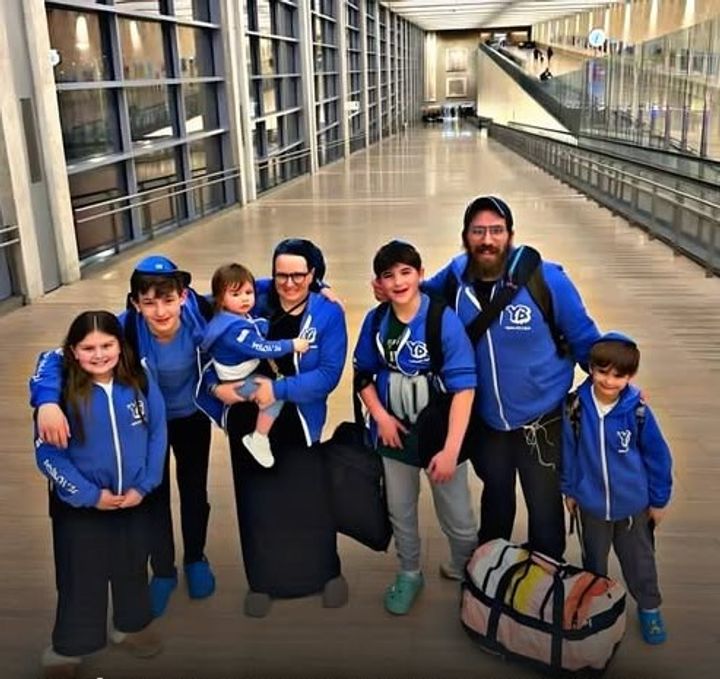
The Buksbein family
The parents, Ilana and Aryeh, came with the family to Israel in the middle of the war, determined to celebrate Yehuda’s bar mitzvah in Israel, no matter what.
“The family of five flew in from New York two weeks ago, at the height of the war, and celebrated Pesach here as well,” Ahuva related.
“I updated them before their arrival that their return flight home had been canceled, but despite everything, they chose to come on a one-way ticket. They didn’t know how or when they would get back. The main thing, for them, was to be in Israel. And the smiles never left their faces.
“So on Sunday night of Chol Hamo’ed, while everyone was talking about Trump’s ultimatum, I had the rare privilege of producing Yehuda’s bar mitzvah celebration in Gush Etzion, in full accordance with the Home Front guidelines. To me, this is a deeply inspiring story. Mazal tov, Yehuda. You have joined the Jewish people at a very special time.”