
This Thursday evening, 17 Adar I, is the second yahrtzeit of Mr. Jacob (Jack) Boehm, zt”l, who was the owner of Jack’s grocery store, a Baltimore icon in the Upper Park Heights community, in the‘70s and ‘80s. His legacy of ehrlichkeit (uprightness), eidelkeit (refinement) and chesed (acts of kindness) lives on in his family.
Photos Credit: Esky Cook eskycook@gmail.com

Mr. Jacob (Jack) Boehm, zt”l
Baltimore, MD - February 25, 2016 - When I reflect on my fond memories of cozy Jack’s, the forerunner of Seven Mile Market, I am amazed. What amazes me most is not its evolution from a tiny circa 1953 lower Park Heights mom-and-pop store to its present 18 aisle, 55,000 square foot Pikesville supermarket in 2010, but the fact that the three-generation family owned and operated business continues to maintain its heimishe feel and superb customer care, despite its growth.
I can still picture the Boehm family working hard at Jack’s, while I took note of the delicious aroma of potato kugel, vegetable soup and other culinary delights that were being cooked in the back room. Mr. Jacob (Jack) Boehm, z”l, the store’s namesake, is schlepping a huge sack of potatoes; his young son, tbl”c, Hershel, is stocking the store shelves with a variety of canned food; and Jack’s wife, tbl”c, Rose, is sitting on a stool while ringing up the orders on her vintage cash register. And, I can still remember the small file box of index cards that she kept by that register, containing the names of people who had bought their groceries on credit. About $20,000 was still owed at the time Jack’s closed. Almost all of that money was paid up.
It is obvious that the Boehms’ benevolence in the Baltimore community and beyond has grown as their business, ka”h, has grown. Seven Mile Market sponsors more causes than you and I will ever know about, I am sure, as the family continues to give back to the community that patronizes them. We all benefit, more than ever, from their heimishkeit and large hearts.
For years, I had the privilege of davening right next to Mrs. Rose Boehm, at Congregation Ohel Yakov, during the Yomim Noraim. The Boehms’ compassion, determination, bitachon and emunah, have always been a source of inspiration for me. Mr. Boehm was very community-minded, and in addition to introducing Baltimore to many new kosher products, he was especially instrumental in establishing Yeshivas Kochav Yitzchok (Shearis Hapleita). For the benefit of those of you who are not familiar with the Boehms’ fascinating story, please allow me to share it……
In the Aftermath of the Holocaust
Little did Holocaust survivors Jacob (Jack) and Rose Boehm dream that their little family run store would blossom into the business it is today. When I interviewed Mr. Boehm for the Where What When, back in 2010, he told me that he was extremely close to his grandfather and spent a lot of time in his grocery/clothing business as a child in Czechoslovakia, and shared: “I remember going to the flea market with my grandfather when I was 14 years old. My grandfather taught me a lot about business. I used to buy walnuts and dried fruits for him from the peasants on the farms, and he would give me suits and money, as pay. I took a liking to business. Finding a job is a hard thing; sometimes you have one, sometimes you don’t. But a business keeps on going.”
It was a miracle that Mr. Boehm survived the war. After he arrived in America, he worked at various jobs before going into business for himself. He told me: “It was very hard to find a decent-paying job here because of the mentality of the old-timers in America; they didn’t like the newcomers. When I first arrived, I got paid 75 cents an hour, minimum wage. I did not know the language. I later worked for a good while in the stockroom of a men’s clothing store, receiving goods. Because the pants and jackets were made in different places, I had to match them and put them together. Another worker who was not an immigrant made more than I did, even though I knew that I was worth more than he was. I went to the boss, who spoke Yiddish, and asked for a raise. He didn’t want to give it to me since I didn’t know English. He offered me half of what he offered the other workers, so I left.”
Mr. Boehm worked as a die cutter for a long time, cutting the paper which would be used for envelopes. His boss liked him so much, he not only excused the fact that he was shomer Shabbos and had to leave earlier during the winter months and take off for the Yamim Tovim, he gave him the key to the place so he could come in at 5 a.m. and leave late at night to make up the time. His boss even paid him overtime, although he told him he didn’t have to. That job lasted until he started to get sick from the dust of the paper and had to quit.
Getting Down to Business
In 1953, Mr. Boehm came home and told his wife that he was starting a business. Mrs. Boehm was scared to take the risk, but her husband courageously rented a store at 3500 Park Heights Avenue and opened a fresh fruit and vegetable store.
Mr. Boehm shared that he couldn’t even afford a cash register or a refrigerator when he first opened. He worked his way up and bought both, and built the shelves for the store, with his own hands. He learned how to drive and bought a used truck, which he drove to the market at 4 a.m. so he could select the best fruits and vegetables for the most reasonable cost. Slowly working himself up, he rented part of the store to someone who sold fish.
Subsequently, after the Boehms visited Rose’s sister, Leah, and her husband, Chaim Lipa (Leopold), in Philadelphia, Mr. Boehm asked his brother-in-law to be his business partner.
The Friedmans were not happy raising their family--their two sons, David and Hershel, nicknamed “Heshy” to avoid confusion [later, a daughter, Chaya Esther, was born in Baltimore] in a neighborhood that was not frum, and the Boehms soon convinced them to move to Baltimore. They lived in a duplex on Park Heights. The Friedmans lived downstairs, and the Boehms lived upstairs. Mrs. Friedman (fondly known to her nieces and nephews as “Tanta Leichu”) babysat for all the Friedman and Boehm children, while Mr. and Mrs. Boehm and Mr. Friedman minded the produce and fish store. Chaya Esther (nee Friedman) Brull and Chana (nee Boehm) Retter are only two months apart; they still share a close relationship having been raised together. In fact, as a young child, Mrs. Retter used to call her aunt, “Mommy”.
Both families made a living, but after a few years the neighborhood changed and there was not enough business for everyone, so the brothers-in-law amiably parted ways (after many years, the Friedmans’ store eventually moved to Rogers Avenue). After the Boehms moved to an empty store on the 5200 block of Park Heights Avenue, near Belvedere, the Friedmans and Boehms now owned separate competing businesses (in this new Upper Park Heights location, for the first time, Mr. Boehm sold groceries, in addition to fresh produce and delicatessen), yet they remained the best of friends. That store location lasted until the building was sold in 1970. The new landlord told him he had to move in two months, or he would double the rent for the following month and would double it each month after that.
“I didn’t know where to go,” Mr. Boehm told me. “I couldn’t find any suitable location and decided I was closing up and what will be, will be. I started selling out my remaining stock and was not purchasing any new merchandise. I took my daughter for a ride on Reisterstown Road and noticed a man putting up a `For Rent’ sign on a storefront. I went over to him and inquired about it. It was a lot bigger than what I had, and he wanted $525 a month. It was in very bad shape. I fixed the store up myself. I sanded, put in counters, and made shelves. Slowly, I filled up the store. We did much more business, and we were able to help a lot of people. We collected a lot of money for people who were not able to pay their bills. Before Pesach, we gave out thousands of dollars. There was no Ahavas Yisroel organization back then. My wife approached a lot of people about giving money, who might not ordinarily give charity. She explained to them that there are a lot of people who can’t afford their food and don’t eat. One older bachelor told her, ‘If you tell me, I know you mean it,’ and he gave her $2,000; she even collected as much as $12,000 for food certificates.”
Growing Up in the Store
Alvin, the eldest Boehm son, recalls spending a lot of quality time with his father, after his partnership dissolved with his uncle and his parents bought the store on the 5200 block of Park Heights.
“At that point, when I was 12 years old, the store was too much work for just my parents and there was an expectation, pretty much from day one, that after school I would be dropped off at the store and help until it closed at 9 p.m.,” recalls Alvin. “I was able to relieve my mother who was working in the store, so she could go home and spend time with my younger brother and sister who were three and eight years younger than me.”
Alvin, who has lived in Brooklyn for many years and is currently employed in the Information Technology (IT) field, has a lot of fond memories of those days. These are just some of them:
“There were very few minyanim in Baltimore for mincha and maariv, back then, and we basically did not leave the store to go daven, but I distinctly remember my father tapping me on the shoulder and reminding me that it was time to daven. We would take turns. I would go to the back of the store to daven mincha, then I would come to the front to man the register and then my father would go to the back of the store to daven. There was certainly no concept of ever missing a davening. He felt very strongly about it. He took it as something that a person would do naturally.”
“In pre-credit cards days, the store gave credit to people who were not prepared to pay every time they came in. There was no such thing as turning someone down. If somebody would say that they weren’t able to pay right now, or they would rather pay at the end of the week when they got their paycheck, it was always an ‘of course’--there was never any discussion of credit worthiness. Most people paid what they could, but many people could not pay in full. One thing that always struck me was the dignity that my parents gave to those people was really impressive. I never, ever heard them remind anyone that their balance was running high and maybe it is time to pay it off. Certainly, I never heard them mention that they would have to cut anyone off from any further credit. They were always very gentle and put the other person at ease. They understood; they never made a big deal about it. They certainly expected everyone to pay their bills, but they were really nice and really forgiving.”
“I remember once, someone who had a balance was driving and their car broke down. The person needed to be towed, but didn’t have money to pay for towing. The person asked the tow truck driver to stop at our store so he could ask my mother if she could advance him the money he needed to tow his car. My mother gave him the cash that he needed. It was just added to his balance.”
“Around Purim time, before Pesach, my father would start to organize food deliveries to people he knew that really could not afford to buy food for Pesach. He didn’t fund it totally himself. There were other people in the community who knew that he was doing this and contributed to it, but he was in charge of putting together the packages and they were delivered by our truck. I remember the instructions he gave to the driver--to park a little bit away from the house where he was doing the delivery, to go quietly to the door, put it down without ringing or knocking, and to come back quickly to the truck so that the recipient wouldn’t see him and wouldn’t have any questions, so he wouldn’t have to explain anything.”
Alvin believes that it is to the credit of the opening of Jack’s that more and more young, yeshivish Ner Yisrael couples decided to settle in Baltimore, beginning in 1965 and 1966, rather than move to New York, as they had in previous years. With the new convenience of having more kosher foods available that met their high standards of kashrus, slowly, the frum community of Baltimore grew, blossoming even more in recent decades.
Alvin’s sister, Chana Retter, also “grew up” in the store. “The bus dropped off me off at the store everyday after school,” reminisces Mrs. Retter. “From the age of five or six, they put me up on a stool and I worked the cash register. Before Pesach, I didn’t go to school; I basically worked in the store. Although I missed a lot of work, I was responsible for making it up, and in my Senior year, our principal, Rabbi BenjaminSteinberg, zt’l, asked me to change my work schedule to alternate days. He realized that my parents needed me. When we moved into the Jack‘s location, I helped out a lot with cooking the hot take out dishes we began to offer, some of which were prepared in the basement of our home.”
Some of Mrs. Retter’s fondest memories are of her parents’ extraordinary chesed. “Once, a woman whose husband was out of town for a little while, came into Jack’s and asked my mother if she could make her purchases on credit [these were pre-credit card days] since she ran out of money for groceries,” recounted Mrs. Retter. “My mother said, ‘Sure!’ and when the woman was leaving, she handed her some cash. She figured that if she was out of money, there were probably other things she would need to purchase while her husband was away. Even when our store was located in the Pimlico area, a mostly non-Jewish neighborhood, my mother was friendly to everyone, knew their stories, and extended them credit.
“We were just good kids,” concludes Mrs. Retter. We saw how hard our parents worked and that they needed us, so we helped as much as we could.”
Hershel Boehm, Alvin and Chana’s brother, who is the present owner of Seven Mile Market, worked at the Jack’s location as young as ten years old, checking out customers on the cash register and packing up their orders on Fridays, so his mother could go home and get ready for Shabbos.
Hershel Boehm, present owner of Seven Mile Market, worked at the Jack’s location as young as ten years old, checking out customers on the cash register and packing up their orders on Fridays, so his mother could go home and get ready for Shabbos.
“When I was 13 or 14 years old, I had to come home from Ner Yisrael to help out on Friday afternoons,” says Hershel. “I used to go on the deliveries to show the drivers the stops. When I was about 19 or 20, and Jack’s had to move out of Park Heights Avenue, I was learning in yeshiva in Eretz Yisrael. As soon as my father found the new location [the store now occupied by Tov Pizza] for Jack’s, he called me to come home. I had no plans at the time of going into business. I thought I would be learning for a while. I let life take its course.
The Boehm Legacy
Even before the elder Boehms were fully retired, Hershel was fully trained to take over more and more of the business at Jack’s. It was in 1988, that he was approached by Josh Gutman, z“l, who owned a wholesale business and a retail butcher shop at the time, with a proposal to join forces and open a supermarket in the Valu-Food building (formerly a Safeway supermarket) on the corner of Seven Mile Lane and Reisterstown Road. After his retirement, the senior Mr. Boehm temporarily left retirement to teach the Seven Mile Market employees how to run the kitchen and appetizing departments.
After the new store opened, the Boehms continued to empathize with and help out kosher consumers who could not afford to buy groceries. “I was worried that some customers would not be able to buy food at times if there was not some sort of credit system in place,” the senior Mr. Boehm told me. “I opened up an account of $5,000 and gave the store head checks, to be used by these families.”
The Boehm family business torch has been passed down to Hershel, who--like his father--works together with his brother-in-law, Simcha Retter. Hershel’s son, Moshe, his daughters, Chani Flamm and Miriam Zayon, and his nephew, Nachum Retter, are among the 100 full- and part-time Seven Mile Market employees.
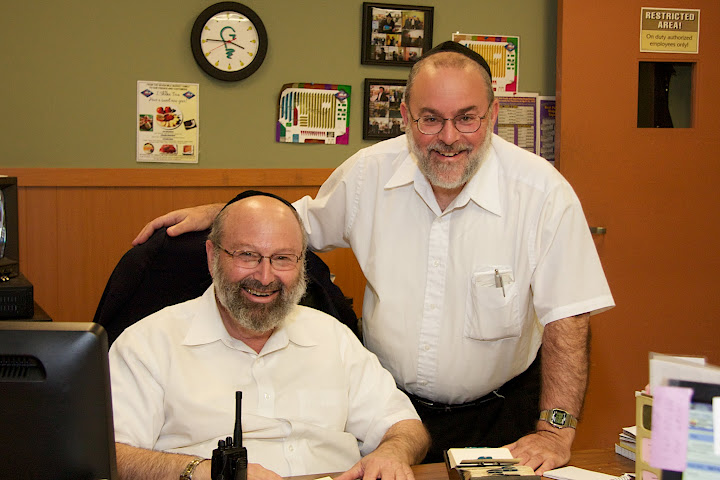
Herhsel Boehm, standing, with his brother-in-law, Simcha Retter

Hershel’s son, Moshe, and other family members are among the 100 full - and part-time Seven Mile Market employees.
Jack Boehm always worked hard from before dawn to night, and when he retired he finished Shas more than once. Even after he retired he still got up early to go to his Daf Yomi and halacha shiur--he was always learning. His devotion to and love of Torah and mitzvos, in addition to his strong work ethic and love of his fellow man, continue to inspire and live on in his children, grandchildren, and great-grandchildren, who follow in his path. In this zechus, amongst others, may the neshama of R’Yaakov ben Avraham Yitzchok, Z'TL, have an aliya.