New York - New York City Council members – a majority of the Council – criticized State Education Department’s new guidelines governing New York’s non-public schools, including the state’s yeshivas.
spearheaded by Brooklyn Councilman Chaim Deutsch to the State Education Commissioner Mary Ellen Elia, the group criticized SED’s “unprecedented incursion into private schools’ curricula” and the “process with which these guidelines have been put forward.”
This letter is signed by members of all faiths and who represent a diverse set of communities.
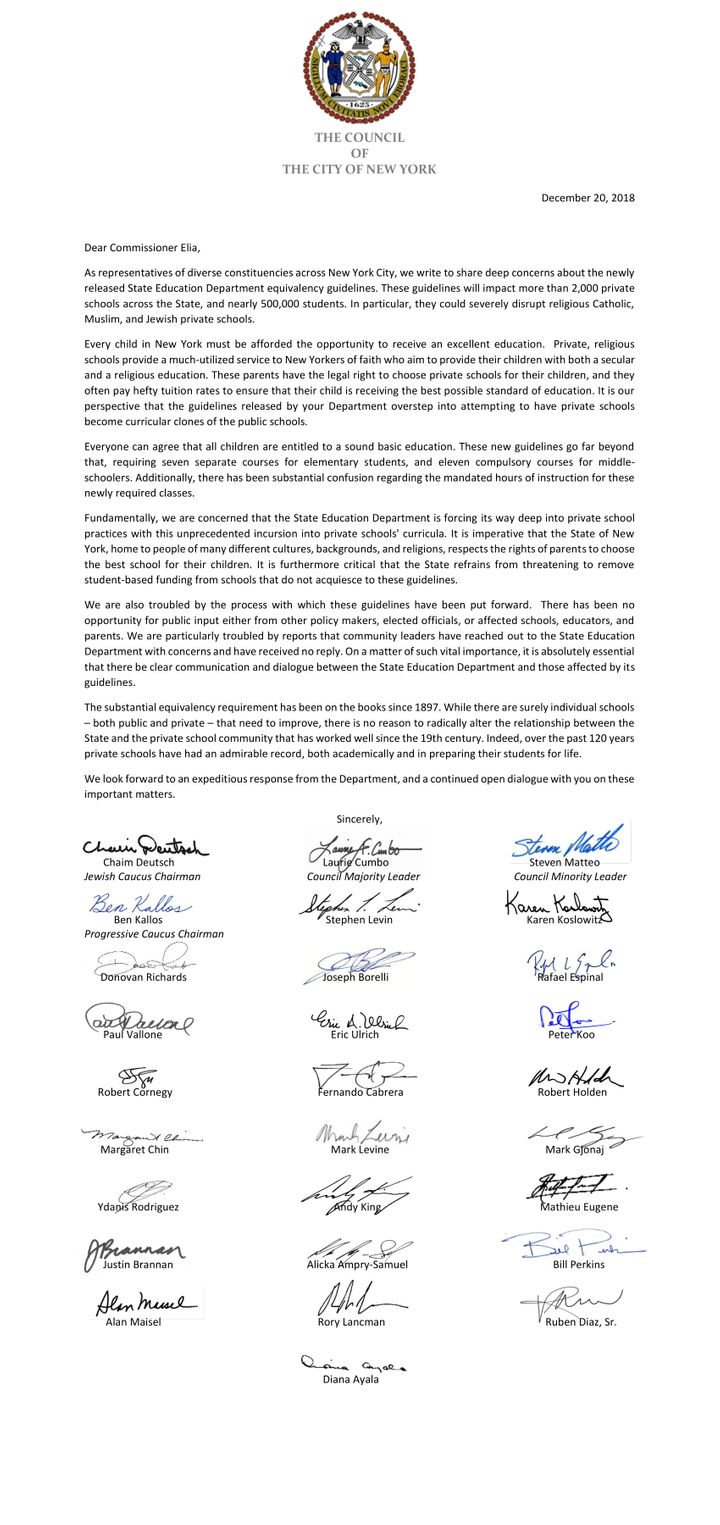
The letter reads:
As representatives of diverse constituencies across New York City, we write to share deep concerns about the newly released State Education Department equivalency guidelines. These guidelines will impact more than 2,000 private schools across the State, and nearly 500,000 students. In particular, they could severely disrupt religious Catholic,Muslim, and Jewish private schools.
Every child in New York must be afforded the opportunity to receive an excellent education. Private, religious
schools provide a much-utilized service to New Yorkers of faith who aim to provide their children with both a secular and a religious education. These parents have the legal right to choose private schools for their children, and they often pay hefty tuition rates to ensure that their child is receiving the best possible standard of education.
It is our perspective that the guidelines released by your Department overstep into attempting to have private schools become curricular clones of the public schools.
Everyone can agree that all children are entitled to a sound basic education. These new guidelines go far beyond
that, requiring seven separate courses for elementary students, and eleven compulsory courses for middleschoolers.
Additionally, there has been substantial confusion regarding the mandated hours of instruction for these
newly required classes.
Fundamentally, we are concerned that the State Education Department is forcing its way deep into private school
practices with this unprecedented incursion into private schools’ curricula. It is imperative that the State of New York, home to people of many different cultures, backgrounds, and religions, respects the rights of parents to choose the best school for their children. It is furthermore critical that the State refrains from threatening to remove student-based funding from schools that do not acquiesce to these guidelines.
We are also troubled by the process with which these guidelines have been put forward. There has been no
opportunity for public input either from other policy makers, elected officials, or affected schools, educators, and parents.
We are particularly troubled by reports that community leaders have reached out to the State Education Department with concerns and have received no reply. On a matter of such vital importance, it is absolutely essential that there be clear communication and dialogue between the State Education Department and those affected by its guidelines.
The substantial equivalency requirement has been on the books since 1897. While there are surely individual schools – both public and private – that need to improve, there is no reason to radically alter the relationship between the State and the private school community that has worked well since the 19th century. Indeed, over the past 120 years private schools have had an admirable record, both academically and in preparing their students for life.
We look forward to an expeditious response from the Department, and a continued open dialogue with you on these important matters.
Sincerely,
Chaim Deutsch, Laurie Cumbo, Steven Matteo, Ben Kallos, Stephen Levin, Karen Koslowitz, Donovan Richards, Joseph Borelli, Rafael Espinal, Paul Vallone, Eric Ulrich, Peter Koo, Robert Cornegy, Fernando Cabrera, Robert Holden,
Margaret Chin, Mark Levine, Mark Gjonaj, Ydanis Rodriguez, Andy King, Mathieu Eugene,Justin Brannan, Alicka Ampry-Samuel, Bill Perkins, Alan Maisel, Rory Lancman, Ruben Diaz, Sr., Diana Ayala