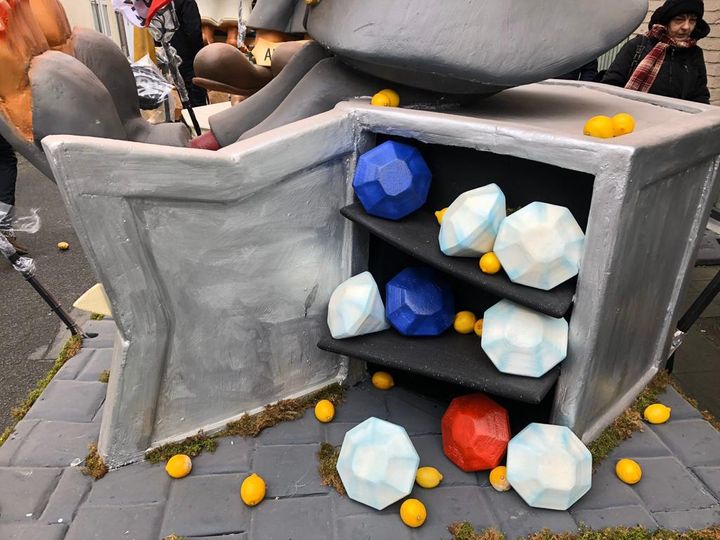
The Belgian city of Aalst on Sunday went ahead with its traditional carnival despite calls from Israel to ban the event over its anti-Semitic floats and costumes. Once again, reported Deutsche Welle, this year's parade included participants dressed in costumes of caricaturistic Jewish stereotypes, with some wearing hooked noses, insect costumes, and exaggerated outfits meant to depict Orthodox Jews. One of the floats also included three Jewish caricatures placed alongside gold bars. Some revelers were also dressed in costumes meant to represent Nazi officers, the report said. Lawmakers in the European Parliament had urged officials in Aalst to make sure this year's parade was free from "manifestations of hatred." This is the second year in the row that the carnival features anti-Semitic tropes. Last year, it featured a float caricaturing Orthodox Jews with hooked noses and sitting on gold bags. Foreign Minister Yisrael Katz on Thursday called on the Belgian authorities to ban the carnival in the city of Aalst. “Belgium as a Western Democracy should be ashamed to allow such a vitriolic anti-Semitic display. I call upon the authorities there to condemn and ban this hateful parade in Aalst,” Katz tweeted. Aalst Mayor Christoph D’Haese said on Thursday that Katz’s call to cancel the festival was “truly disproportional.” “I absolutely call on people to avoid these sensitive subjects,” he said in an interview with the VRT network, as quoted by The Associated Press. “But that is something completely different than the ban which is called for here.” On Sunday, D'Haese again dismissed the criticism and calls for a ban on the festivities, saying "let Aalst be Aalst." "This is not an anti-Semitic parade," he told reporters, according to Deutsche Welle. "Aalst is not an anti-Semitic city." In December, UNESCO, the UN’s culture committee, withdrew the Aalst carnival from its heritage list over the anti-Semitism. D'Haese initially defended the presence of the anti-Semitic float, saying that “it’s not up to the mayor to forbid” such displays, and that “the carnival participants had no sinister intentions.” However, ahead of UNESCO's decision to withdraw the carnival from its heritage list, D'Haese renounced Aalst's place on the list before it could be stripped of the designation. PINNED Scroll for more news 

When one of our babies needs help, we all show up
That's what our community does. We take care of each other, especially the littlest ones.
Right now, a 3-month-old baby named Baruch is in the hospital fighting a serious kidney condition. His treatments aren't fully covered, and no family should have to carry that alone.
So let's carry it together. Every gift, big or small, helps a family focus on what matters most: getting their baby healthy and home.
I look at my tiny baby sleeping peacefully in the ICU.
But my heart knows the truth this is only the beginning of our battle.
A battle for his life and for my strength to keep going.
My name is Miriam.
My baby’s name is Baruch.
He is only two months ...

Prime Minister Benjamin Netanyahu’s Likud party has reportedly discussed challenging Israel’s election results if he loses, with party operatives preparing allegations of possible voter fraud in Arab communities.
Likud was preparing complaints concerning polling stations in Arab towns, while Haaretz reported that party figures had discussed claiming the election was “stolen” if Netanyahu failed to win. One source close to Netanyahu said discussions had included a campaign similar to President Donald Trump’s claims of widespread fraud after the 2020 U.S. election.
The reports come amid concerns over Likud’s plans to send thousands of activists to monitor polling sites in Arab-majority communities. The activists have no official authority to demand ident...

Israelis turned out in higher numbers than in the last election during the first hours of voting for the 26th Knesset on Tuesday, with turnout at 16.7% as of 10 a.m. Israel time, according to Israel's Central Elections Committee.
That compares with 15.9% at the same hour in the 2022 election. About 1.2 million votes had been cast by 10 a.m., which The Times of Israel said was the highest turnout at that hour since at least 1996, the year Prime Minister Benjamin Netanyahu won his first term.
The committee's official hour-by-hour turnout records only go back to 1996. Some media reports, citing archival figures that may not be precise, said it was the highest turnout since the 1981 election.
Turnout among IDF soldiers was also running higher. According to the military, 30% of sol...

Port Discovery Children's Museum in Baltimore will open a new exhibit called B'More You in the summer of 2027, the museum announced.
The museum said the exhibit draws on the "energy, creativity, and connection of Baltimore neighborhoods."
B'More You will cover 4,500 square feet and will include a park and a rowhome modeled on Baltimore's own. Its activities are designed to help children solve problems, work together and explore the world around them.
The new exhibit will take the place of Adventure Expeditions, one of the museum's original exhibits, which closed in September.
According to the museum, some elements of Adventure Expeditions will be preserved, repurposed or reimagined as part of the new space.
B'More You is part of a larger plan by the museu...

The FBI has arrested a CIA contractor accused of leaking classified defense and Middle East intelligence to a person who then published it online, according to the U.S. Department of Justice, The Jerusalem Post reported.
Ian Brinksman, 42, was arrested on Friday. According to the Justice Department, he has worked at a Virginia-based U.S. government agency since 2020 and was hired by a contractor to that agency in 2022. He held a Top Secret clearance with access to Sensitive Compartmented Information.
CIA Director John Ratcliffe confirmed that Brinksman provided services to the CIA as a contractor.
According to the criminal complaint, Brinksman had an ongoing personal relationship with a person the Justice Department calls "Individual 1," who said she had published reporting based on cla...
BaltimoreJewishLife.com (BJL) is proud to partner with STAR-K CERTIFICATION that realizes that there is no substitute for a person’s own Rav. In an effort to offer a possible solution, it has launched its Institute of Halachah as a public service. Over the years, the agency’s Kashrus Hotline has answered generic halachic questions from kosher consumers the world over, including inquiries regarding the kosher status of foods and certified Sabbath mode appliances. The formation of a separate official division within STAR-K testifies to the need for addressing these issues. The Institute of Halachah is directed by HaRav Mordechai Frankel, under the guidance of HaRav Moshe Heinemann, STAR-K’s Rabbinic Administrator. It is an invaluable resource for a diverse array of rabbis to discuss general halachic matters, as well as gain access to source materials for shiurim and answers to congregants’ questions. Shailos for regular or Kashrus shailos may emailed or discussed using this widget. 
Baltimore Mayor Brandon Scott has signed an executive order describing how the proposed Baltimore Baby Fund would provide financial help to families with newborns if city voters approve it on November 3, WMAR-2 News reported.
The measure will appear on the ballot as Question I, according to WMAR-2's earlier reporting.
Under the plan, every Baltimore City newborn enrolled in the program would be eligible for a one-time cash payment. The amount has not been set.
Some expectant and new parents could receive more help depending on eligibility. That could include a payment during pregnancy, monthly cash assistance after the baby is born, and a contribution to a Maryland 529 college savings account.
Families could also be connected with B'More for Healthy Babies for care coordinati...

Click on image to view full weekly specials.

Dictionary.com has named “maxxing” its 2026 Word of the Year, recognizing a popular online trend centered on maximizing or improving different aspects of life.
Derived from “maximizing,” the term is paired with other words to describe specific goals. “Looksmaxxing” focuses on improving physical appearance, “sleepmaxxing” on getting better sleep, and “gymmaxxing” on improving fitness. The trend has spread across social media, with some variations focused on serious self-improvement and others taking a more humorous approach to everyday activities.
So, what about Torahmaxxing? It could mean adding another chavrusa, squeezing a few extra minutes of learning into the day, or finding more opportunities to do chessed. If people are lo...

President Donald Trump renewed his public endorsement of Israeli Prime Minister Benjamin Netanyahu on Sunday, urging Israelis to reelect him in Tuesday’s election and declaring that the two leaders must “finish the job” against Iran.
In a post on Truth Social, Trump repeated an endorsement he first issued a week earlier, saying he and Netanyahu had worked well together and describing the Israeli prime minister as an “outstanding warrior prime minister.”
Trump credited their partnership with military operations against Iran, claiming that the country’s military and economy had been severely weakened. He also pointed to the naval blockade and the removal of senior Iranian leaders as evidence of the campaign’s impact.
“Vote for Bibi Netanyahu...

Hashem is different. He is unlike anything in the world He created. No physical description captures His essence. Whenever we describe Him, we rely upon approximations, using language and images that the human mind can comprehend. Hashem exists beyond human experience and understanding.
So are we. Hashem created us different from the natural world. He gifted us with traits which distinguish us from the rest of creation: self-awareness, complex emotions, cognitive speech, creativity, imagination, dreams, and social and political instincts.
Chief among these qualities is our free will. We can choose between right and wrong. Hashem implanted within us a moral instinct to distinguish good from evil. He also revealed His will to help us navigate a complex world.
The gift of free will lends...

Johns Hopkins Bayview Medical Center is notifying 3,182 patients that some of their personal health information may have been exposed after a hospital worker uploaded a spreadsheet of patient data to an outside artificial intelligence tool that the hospital had not approved.
The hospital said it discovered the problem on September 21, 2026, during an internal review. According to the report, the upload took place that same day.
The spreadsheet covered patients who were admitted and treated at the hospital between May and September of this year.
Information that may have been exposed includes patient names, admission and treatment dates, medical record numbers, account numbers, the department that provided treatment, medications given and the names of providers.
The hospital said the sp...

Baltimore, MD – October 26, 2026 - A person of interest was taken into custody after a fire broke out Sunday evening at a mosque on Harford Road in East Baltimore.
Firefighters responded shortly after 5 p.m. to the 2600 block of Harford Road, near Clifton Park, where the building was engulfed in flames. Crews worked to extinguish the fire, and police took a person of interest into custody in connection with the incident.
No injuries were reported. Authorities have not released further details about the investigation, and the cause of the fire has not been confirmed.
This article was independently written by the BJL Newsroom based on reporting from The Baltimore Sun and WBFF.

Three Small Stories, One Important Message
The following are three special messages I received this week which I’d like to share here. Each is beautiful and moving in its own right, but together they reminded me of our strength and unity—and of something we may have lost sight of amid the election campaigning.
1. The first message came from Sderot. A group of tenth-grade girls from the city's Be’eri Ulpana recently took a trip to Kiryat Shmona. They encountered a city coming back to life, with new families moving in, but they also saw the enormous challenges it still faces. So they decided to return this week, this time with a different purpose.
"We're heading to Kiryat Shmona, all the way from Sderot, for three days of volunteering and community service. ...

Baltimore, MD – October 24, 2026 - BJL regrets to inform the community of the petirah of Fred Edinger z"l, father of Naftoli Edinger.
Naftoli is currently sitting shiva in Monsey. He will return to Baltimore for a 10:00 pm Maariv on Tuesday night and will continue sitting shiva at his home, 2934 Bartol Avenue, through Thursday morning.
Davening Schedule:Tuesday - Maariv: 10:00 pmWednesday and Thursday - Shacharis: 7:30 amWednesday - Mincha/Maariv: 5:55 pm
בלע המות לנצח

Baltimore, MD – October 25, 2026 - The Baltimore community is invited to a special Hilula Seudah tonight, Sunday, October 25, marking the yahrzeit of Hagaon Rav Michoel Eliezer HaKohen Forshlager, zt”l, a distinguished talmid of the Avnei Nezer, zt”l.
The seudah will take place at 8:30 PM at Kahal Chassidim, located at 6004 Park Heights Avenue, Baltimore, under the leadership of Rabbi Amram Yosef HaLevi Jungreis, shlit”a.
In conjunction with the yahrzeit, the cemetery will remain open throughout Sunday night and all day Monday for those wishing to daven at Rav Forshlager's kever, which is known as a place of tefillah and yeshuos.
Cemetery Location:3701 Southern AvenueBaltimore, MD 21206
For additional information, sponsorship opportunities, or dedications l...

A Baltimore County mother says she fears for her children’s safety after a man living in a sewer near her home allegedly spoke to them and chased them down the street.
Unique Wiggins said she initially did not believe her children when they described their encounters with the man. After hearing similar complaints at least four times, she decided to investigate herself.
"It was a Friday, and my daughter, who is 21, called and she was panicking. And I asked, 'What's wrong?' And she said, 'Mom, I'm scared. The man told me I can't walk right here and to just dip.' And I'm like, 'What man?' And she was like, 'The man in the sewer.'"
"I walk over to the little manhole sewer thing, and I hear somebody singing, and I think, �...

Karthikeyan Deenadayalan, chief engineer of the Dali cargo ship involved in the deadly 2024 Francis Scott Key Bridge collapse, was prevented from boarding a flight from India to Baltimore earlier this week by U.S. Customs and Border Protection. Deenadayalan had been visiting family in India, and his attorneys said the reason for the travel restriction has not been made public.
Deenadayalan entered into a deferred prosecution agreement in June 2026 over his role in the case. The Dali lost power and struck the Key Bridge on March 26, 2024, killing six construction workers and closing the Port of Baltimore’s main shipping channel for weeks.
According to the Justice Department, Deenadayalan admitted that he knew the ship was using an unsafe fuel supply pump and failed to notify the U.S...

Baltimore, MD – October 23, 2026 - Torah Institute/Yeshivas Kochav Yitzchak kicked off its annual Chemdas Mishnayos program on Thursday with an inspiring BYOM (Bring Your Own Mishnayos) event. Nearly 600 talmidim in grades 3–8 gathered in the gym for a tremendous Maamad HaTorah, collectively learning well over 1,000 perakim of Mishnayos.
The Chemdas Mishnayos program, established many years ago by Rabbi Juravel, is now led by Sgan Menahel Rabbi Reischer. The special gathering featured divrei chizzuk from fifth-grade Rebbi Rabbi Heineman, who encouraged the boys to strengthen their commitment to Torah learning and make the most of the opportunities ahead.
Adding to the excitement, each talmid received a bag of chips and a can of soda to celebrate the occasion.
The powerful si...

Baltimore, MD – October 23, 2026 – BJL regrets to inform the community of the petira of Mrs. Anita Polovoy, a”h, who served as the Executive Secretary at TA for over 35 years.
The levaya will take place on Sunday, October 25, at 10:00 a.m. at Sol Levinson’s.
Kevurah will take place at Hebrew Young Men’s Cemetery, 5824 Windsor Mill Road, Gwynn Oak, MD 21207.
בלע המות לנצח ומחה ה׳ דמעה מעל כל פנים

Baltimore, MD – October 23, 2026 - BJL wishes a hearty Mazel Tov to Rafi & Chedva Cohn on the birth of a daughter.
Mazel Tov to grandparents Jeff Cohn (Karen, a’h) and Rabbi & Mrs. Zvi & Esti Zuravin.
!יה"ר שיזכו לגדל את בתם לתורה, לחופה ולמעשים טובים. אמן
|
Watch: Anti-Semitic Belgian Carnival Goes Ahead Despite Calls For It To Be Cancelled (Video & Photos)
The Belgian city of Aalst on Sunday went ahead with its traditional carnival despite calls from Israel to ban the event over its anti-Semitic floats and costumes. 
|