Dr. Michael Elman has been privileged to care for a number of leading Torah giants during his 30 years as an ophthalmologist. What he has received from them, he says, is far more than he has given
When Dr. Michael Elman looked up into Rav Elyashiv’s eyes, he saw Torah leaders of the past, the travails of Klal Yisrael, and page after page of learning.
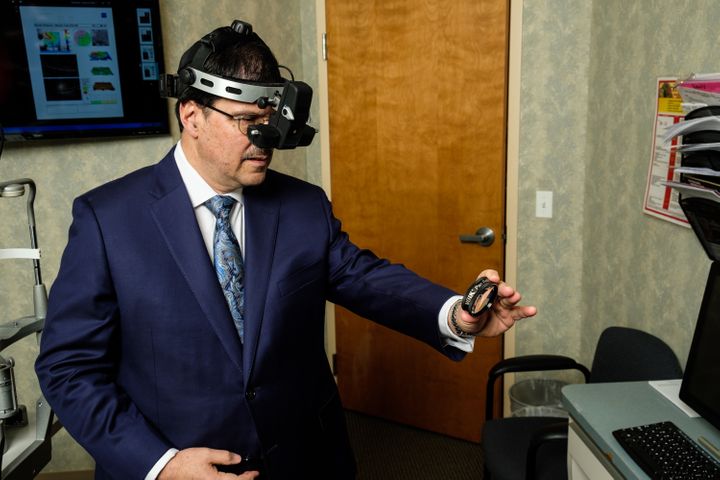
He had been summoned to the gadol’s house on a Motzaei Shabbos to conduct an eye exam. An ophthalmologist with a specialty in the treatment of the retina and vitreous (the liquid part of the eye), this was the first time Dr. Elman had examined the elder Rav Elyashiv, who was then in his 90s. On the spot, he took a medical history.
“There was no medication list, no prior history or exam notes; basically, nothing to review,” says Dr. Elman, who is the founder of the Elman Retina Group, a private retina practice in Baltimore, and an assistant professor of ophthalmology at the Johns Hopkins University School of Medicine. “Rav Elyashiv was very patient and kind.”
Because the Rav’s neck was bent from so many years of Torah learning, Dr. Elman had to get down on the floor and look up into the gadol’s eyes to conduct the examination. “As I looked into his eyes, I realized that these were eyes that had seen the gedolim of the last one-hundred-plus years and witnessed the most tumultuous century in our history since the Churban.”
Dr. Elman says that, amazingly, Rav Elyashiv’s retina showed virtually no age-related degeneration.
(Photo Credit: Reb Eli Greengart)
It has been the unique privilege of Dr. Elman, 62, to care for not only Rav Yosef Shalom Elyashiv ztz”l, but also Rav Aharon Yehuda Leib Steinman ztz”l, Rav Nosson Tzvi Finkel zt”l, and other Torah giants over 30 years as a retina specialist. In addition to an active life in community affairs — Dr. Elman is senior vice-president for the Union of Orthodox Jewish Congregations of America, youth commissioner for NCSY Atlantic Seaboard Region, and a founding executive board member of Agudath Israel of Maryland — he is the author of more than 250 scholarly works and one of only 280 ophthalmologists worldwide elected to the elite American Ophthalmological Society.
Dr. Elman says he feels blessed to have been chosen to serve great people.
“Through my profession I have gained unparalleled access to gedolim in a manner that I otherwise would never have experienced,” Dr. Elman says. “This privilege has had a profound impact not only on my life but on the lives of my entire family; you cannot put a price on that. I don’t know why I merited to have that privilege, and it is one for which I will always be grateful.”
Clarity in a Murky World
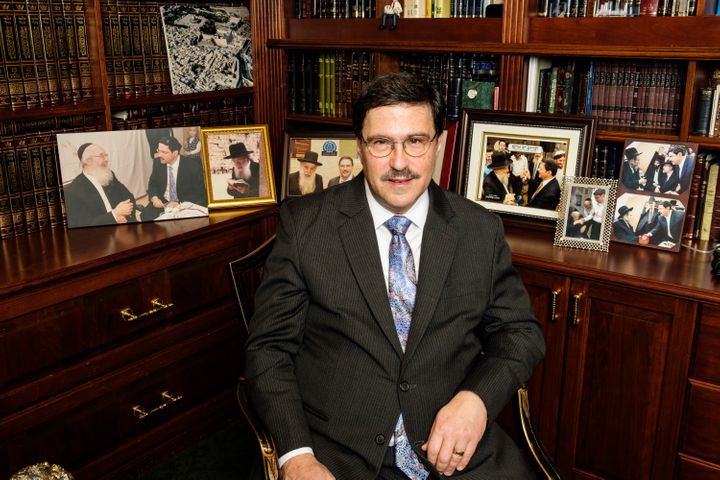
Dr. Elman is a native of Detroit who learned in the mechinah and beis medrash of Yeshiva Beth Yehudah. He later completed his retinal training at Washington University in St. Louis and The Johns Hopkins University in Baltimore. Married and the father of four, Dr. Elman splits his time between Baltimore and the Old City of Jerusalem, where he also maintains a residence. On this day, we meet in his cozy, seforim-lined Baltimore study, where roshei yeshivah and rebbetzins have been received for decades. Settling in one of the two regal upholstered English Hepplewhite chairs, Dr. Elman elaborates on the special qualities of gedolim.
“If you look carefully, you will understand that the light they are radiating is the Shechinah,” Dr. Elman explains. “You feel the kedushah. To me it is clear our gedolim have special ‘ruchniyus antennae.’ Furthermore, in many cases I’ve seen, it doesn’t make sense that they are living with the medical problems that they have, let alone functioning at a high level. I know that in the case of Rav Steinman, he ate very little for decades. His energy came from Shamayim — not from the food.”
One common thread that Dr. Elman observed in the gedolim (and their family members) across the spectrum is their tremendous middos, their very kind, soft-spoken, measured words, and their high esteem for the medical profession.
“They are very down to earth and exceptional human beings,” Dr. Elman says. “They are characterized by their emes and clarity in a murky world filled with subtleties and apparent contradictions. Universally, they exhibit immense empathy and boundless ahavas Yisrael.”
Dr. Elman says Rav Elyashiv reminded him a lot of his own father, who was a few years older than the Torah great but never had the opportunity to learn. They both grew up in Russia, lived through the Russian Revolution, spoke Yiddish with a litvishe dialect, and were very measured with their words. “I felt very much at home when I spoke with him.”
Although, Rav Elyashiv insisted on paying Dr. Elman after that late-night exam, he refused, explaining that he doesn’t accept payment from rabbanim.
“He pushed money toward me and I gave it back as a donation to tzedakah,” recalls Dr. Elman. “I thought about this more, after I left his house, and called back to say that I changed my mind about charging — my payment would be that the Rav should daven for my family, every day. He agreed. No question I got a great deal for an exam that I would have paid for the zechus to perform. This was priceless!”
Dr. Elman notes that Rav Elyashiv, and all the other gedolei hador he has examined, exhibit an abundance of hakaras hatov — above and beyond the average patient. A case in point occurred when Dr. Elman paid a shivah call to Rav Elyashiv, after his daughter, Rebbetzin Leah Auerbach, passed away.
“The whole world came to be menachem avel, and the way it works is that the long line of visitors quickly files past the aveilim,” Dr. Elman recalls. “They picked me out of this line and insisted that I sit down. I told the family I didn’t want to be matriach them, but was told, ‘No, you sit!’ They even asked me if I wanted to stay for Minchah. Just to stand next to the gadol hador and watch how he davened was amazing.”
Dr. Elman says he has met many famous people during his working career who are “anything but humble,” but Rav Elyashiv was the opposite. “He was straight without any negios. He was gentle and no-nonsense. As I reflect on my career, I cannot imagine anything that compares with the zechus of serving in Rav Elyashiv’s care. I was privileged to be an eved b’paltan HaMelech.”
Dr. Elman tells another story about Rav Elyashiv that illustrates his acute sensitivities. Dr. Elman serves as a consultant to an Israeli startup company, Notal Vision, that has developed a machine to detect early “wet” neovascular age-related macular degeneration. He wanted Rav Elyashiv to use this machine for his care but first he needed to determine if it was appropriate for him. Between Yom Kippur and Succos of 2010, he was told to be at the Rav’s house one evening. Gidi Benyamini, an executive with Notal Vision, met him there, where the two set up the machine in a back room while Rav Elyashiv learned in the front.
Rav Yosef Efrati, a close talmid, and Rav Elyashiv’s grandson, Rav Aryeh, went to work evaluating the machine, but after ten minutes, they both concluded it was not for Rav Elyashiv. “Ha-achbar, the mouse,” they said. At 100 years old, Rav Elyashiv was not exactly computer literate and they did not believe he had the dexterity for such a device.
“Gidi was crestfallen,” Dr. Elman recounts. “Seeing this, Rav Efrati and Rav Aryeh ushered us into the Rav’s room and plopped the large box right onto Rav Elyashiv’s Gemara. Since Rav Elyashiv was hard of hearing, they screamed in Yiddish, ‘Zeide, we have people who have built a device to help people see. Please give them a brachah.’ Rav Elyashiv answered, ‘Brachah v’hatzlachah.’ At that moment, my son-in-law Moshe, who was standing in the background, snapped a picture. I turned to Gidi and remarked, ‘Do you know what just happened? You just became a multimillionaire.’ He looked at me as if I was crazy. I explained, ‘You just received a brachah from the gadol hador. Your machine is bound to work. Not only that, but my son-in law’s picture means your machine will fly off the shelves in the two Bs — Bnei Brak and Brooklyn.’ Gidi proudly shows this picture to every frum ophthalmologist he meets.”
As a post-script, Dr. Elman says that the US clinical trial for the Notal Vision system was stopped early, a rare occurrence in research, because the machine worked so well. Furthermore, Medicare approved payment in only two years, half the expected time. “Even the secular officials at Notal acknowledge that the machine’s success stems ‘from the blessing of the Rabbi.’ ”
A Special Guest
Dr. Elman’s close relationship with Mirrer Rosh Yeshivah Rav Nosson Tzvi Finkel ztz”l, was multifaceted. Rav Nosson Tzvi came to Baltimore only once, a few months before he passed away.
“Rav Nosson Tzvi was an extraordinary and sensitive person,” Dr. Elman says. “Our daughter, Aliza, is a great baker, and she baked muffins that we served him. After tasting them, he remarked, ‘Who made these muffins? These are unbelievable muffins!’ We felt as if we were hosting royalty.”
Dr. Elman says the rosh yeshiva’s Torah was “incomparable.” “I would sit next to him on Friday afternoons, when I attended his shiur on the parshah in Yerushalayim. Just watching him was a mussar schmooze — the Torah was extra. No one has an excuse for letting anything stop him — whether it is illness or being tired or weak — after you saw what Rav Nosson Tzvi could do.”
The last time Dr. Elman saw Rav Nosson Tzvi was Chol Hamoed Succos, in 2011, when he walked in the extreme heat from his home in the Old City to the Rosh Yeshivah’s kabbalas panim in his succah. “Right before we came, Rav Zundel Kroizer ztz”l, a very famous Yerushalmi, and also a patient, arrived,” remembers Dr. Elman. “He was a chavrusa with Rav Nosson Tzvi. When Rav Zundel left, Rav Nosson Tzvi said to me, ‘There goes a very holy Jew.’ I thought to myself, ‘It takes one to know one!’ ”
Dr. Elman also had the zechus of examining Rav Aryeh Finkel ztz”l, the Rosh Yeshivah of Mir-Brachfeld, who is the grandson of Rav Leizer Yudel Finkel and a cousin of Rav Nosson Tzvi.
“The first time, I didn’t really realize who it was that I was called home to examine,” admits Dr. Elman. “Had I known, I would have traveled to Brachfeld; he didn’t have to travel to see me. Again, there was tremendous hakaras hatov. I just gave him my opinion; I didn’t operate on him.”
Dr. Elman also fondly remembers the brachah he received for professional success from Rav Dovid Lifshitz, the “Suvalker Rav,” with whom his family was very close. The rav was also the Elmans’ mesader kiddushin.
“Rav Lifshitz took my hands and said, ‘I can’t give you a brachah that people should be sick, because we don’t want anyone to be sick, but I’ll give you a brachah that those who are sick should come to you and you should be the shaliach to give them a refuah.’ So, if I have any success, that’s his brachah at work.”
Lessons Learned
Although Dr. Elman had met Rav Steinman ztz”l, on a number of occasions, he examined him only once.
“Rav Steinman had a tremendous sense of hakaras hatov; he also had a wonderful sense of humor,” Dr. Elman says. “When I finished examining him and said goodbye, Rav Steinman said, ‘I’m going to a bris. Don’t you want to come with me?’ I said, ‘No, I don’t want to be matriach the Rosh Yeshivah.’ He said incredulously, ‘What? You don’t want to be mekabel panim with Eliyahu Hanavi?’ I said, ‘Okay!’ So, we piled into the van.”
Rav Steinman sat in the front seat while Dr. Elman and his son-in-law, Moshe Meystel sat in the back. They drove a few blocks to a bris in Bnei Brak and were greeted by a sea of people when they arrived.
“The door opened and it was like Kri’as Yam Suf — and who walks out? Not Rav Steinman — Moshe and me!” Dr. Elman recalls. “They all looked at us — not what they were expecting!” Rav Steinman soon followed, and the crowd, like the sea, parted.
(Photo Credit: Reb Eli Greengart)
Back in 2011, before Dr. Elman even treated Rav Steinman, the gadol hador wrote a letter that was published in Hamodia, “Miracles We Can Learn From,” which referred to a yeshuah that had happened to Dr. Elman and his fellow passengers on an El Al flight.
He had fallen asleep shortly after takeoff on one of his numerous Israel to US flights, unaware that the plane was seriously at risk to crash upon landing due to possibly damaged landing gear. It circled over the Mediterranean, dumping its fuel into the sea, while waiting for daylight so the Israeli Air Force could visually assess if the plane could land. Thanks in part to Dr. Elman’s daughter-in-law, Inbal Elman’s Facebook post, which went viral, people across North America were davening for the plane; those in Eretz Yisrael and Europe were already asleep. Shuls said Tehillim and even weddings were abruptly stopped to say Tehillim. Dr. Elman woke up at landing and saw that Ben Gurion had been shut down for the hundreds of emergency vehicles that were standing by for the expected mass casualties.
“We thought it was a false alarm,” Dr. Elman says. “When Boeing came out a few days later to investigate, the engineers from Seattle declared, ‘This plane should have crashed. The wheel was hanging by a thread; it is a miracle this plane landed.’ One month later Rav Elyashiv paskened that every time I land in Ben Gurion, as the plane touches down, I should say, b’Shem u’Malchus, the brachah “…she’asah li nes b’makom hazeh — Hashem made a miracle for me in this place.”
In his letter, Rav Steinman explained that he was highlighting the deliverance because this generation needed to see that when they davened they got an answer.
Dr. Elman concludes with a keen insight. “The gedolim take seriously the mitzvah of u’shmartem es nafshoseichem,” he says. “There are a lot of people who do what I do at a high level, and they certainly can take care of gedolei Yisrael both here and in Eretz Yisrael. I don’t know why I merited to have that privilege, and it is one that I cherish.”