
"They Say There Is a Land"
Longing for Eretz Israel during the Holocaust
Holocaust survivors whose stories are presented in the exhibition will attend the opening on 29 May 2018
Marking the 70th anniversary of the establishment of the State of Israel, Yad Vashem, the World Holocaust Remembrance Center, launchrf a new unique exhibition entitled, "They Say There is a Land: Longings for Eretz Israel during the Holocaust." The exhibition, housed in the Auditorium Exhibitions Hall, opened to the public on Tuesday, May 29, 2018.
Through artworks, artifacts, diaries, letters and testimonies collected by Yad Vashem over the years, the exhibition demonstrates how Jews yearned for Eretz Israel during and immediately following the Shoah in the years 1933-1948 – from the rise of the Nazi party to power in Germany, through the outbreak of World War II and the destruction of European and North African Jewry, and until the end of the war and the establishment of the State of Israel.
The exhibition, "They Say There is a Land" is divided into three chapters. The first chapter presents how Jews viewed their connection to and longing for the Land of Israel during the time of the rise of the Nazi party to power in Germany until the outbreak of World War II. It was during this period that Jews searched for asylum in various countries, including Eretz Israel.
The second chapter focuses on the years 1940-1944 from the period of the ghettos to extermination. During this stage, the Jewish communities in Europe dwindled, and under their daily struggle for survival, many Jews found themselves distanced from Eretz Israel to the point of disengagement, however, their hearts' yearning for the Land was never stronger.
The third chapter focuses on the period of the aftermath of the Shoah, the Displaced Persons camps in Europe and the detention camps in Cyprus, until the establishment of the State of Israel. At this time, many survivors felt that in the Land of Israel they would be able to regain their stature and build a full Jewish communal and personal life.
Over the years, even from the depths of despair and destruction, Jews prayed for their return to Zion – Eretz Israel, the Land of Israel. For most, however, Eretz Israel was only an idea, a dream. Jewish affinity to Eretz Israel was expressed in prayer, philosophy, poem and song, in life-cycle events and on Jewish holidays.
Baruch Milch, who thought he would never see the Land of Israel, wrote while in hiding in Poland to his cousin in Eretz Israel: “I am writing this letter to you as one who has been condemned to death before my execution, since this is my situation right now... The Jews need freedom… Only in [Mandatory] Palestine will they be granted independence... Do not be silent; work day and night until you achieve this goal."
"The Shoah completely changed reality," explained Exhibition Curator and Director of Yad Vashem's Museums Division Vivian Uria. "During this period, Jews experienced the breakdown and destruction of the entire fabric of life for both the individual and the community. Yet documents, diaries, letters, artifacts and artwork documenting the period testify that even during those terrible times, in the midst of the struggle for life that focused on the here and now, Eretz Israel held a firm place in the hearts and thoughts of Jews."
The title of the exhibition comes from the poem by celebrated Hebrew poet Shaul Tchernichovsky. "They Say There Is a Land," which he wrote in 1923 in Berlin, brings up existential questions that characterized the Jewish people's struggle with its future, as well as the forces of dream versus reality, and hope versus despair.
Yad Vashem Chief Historian Prof. Dina Porat was the Historical Adviser for the exhibition.
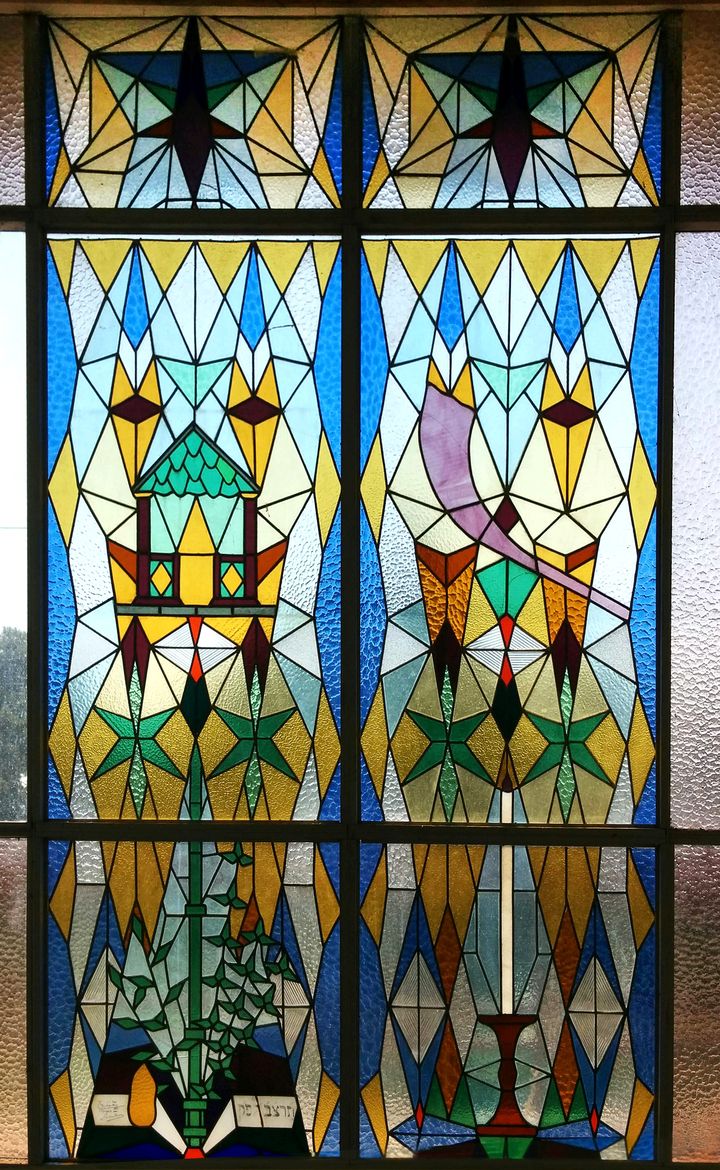
Stained-glass windows planned and designed by Architect Abraham Van Osten in 1932 and installed in the synagogue in Essen, Holland. With the deportation of the Jews of the Netherlands to the extermination camps, including members of the Van Osten family, the Jewish community of Essen was destroyed.
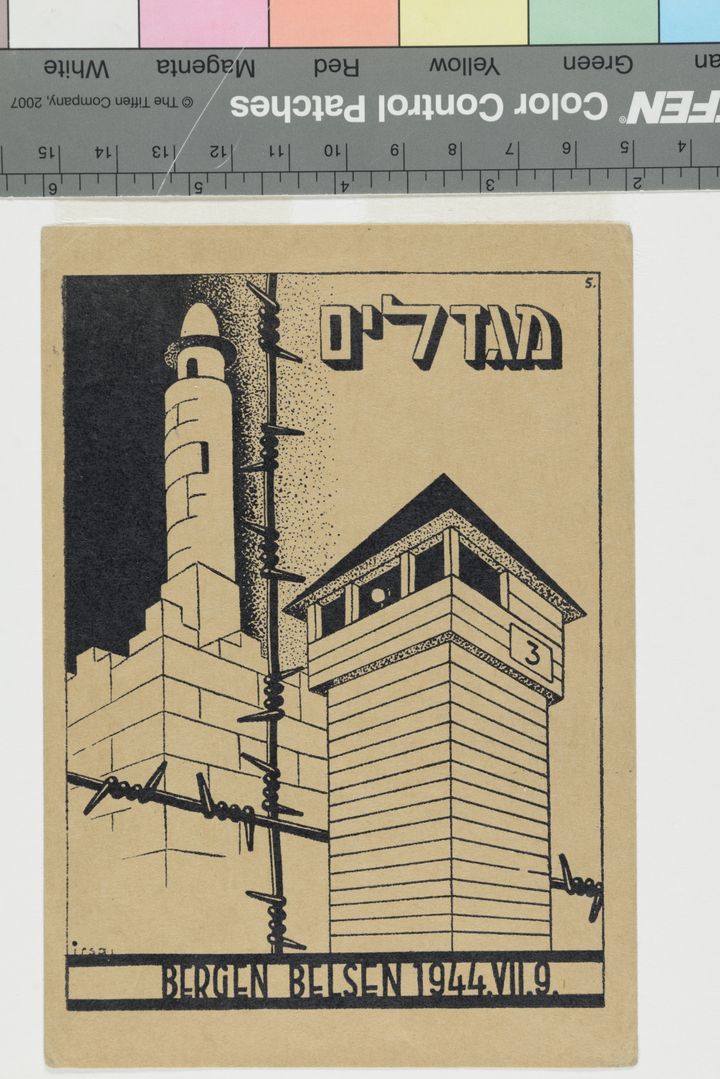
Irsai, Istvan (1896-1968), Towers, Bergen-Belsen,
July 9, 1944, etching, 14.8x10.3 cm
Yad Vashem Art Collection. Gift of Dr. Bendek
Pesach Stephen (Istvan) Irsai studied architecture in the Budapest Technion, and music at the city‘s Royal Academy. In addition to his work as a self-employed graphics designer, he was active in local Zionist organizations, and managed the publicity division of the Keren Kayemet Leyisrael (JNF) and Keren Hayesod. In the mid-1920s, Pesach married and immigrated to Eretz Israel, where he continued his graphic work. In 1929, he returned with his family to Hungary. He resumed his jobs at the Zionist institutions, and was employed by the civil service, working in the Hungarian Prime Minister‘s office. In July 1944, Pesach, his wife and two children were sent to the “Hungarian Camp“ in Bergen-Belsen on the “Kastner Train.“ In December 1944, the group was liberated from Bergen-Belsen to Switzerland, and in September 1945 the artist‘s family arrived in Eretz Israel. They settled in Tel Aviv.
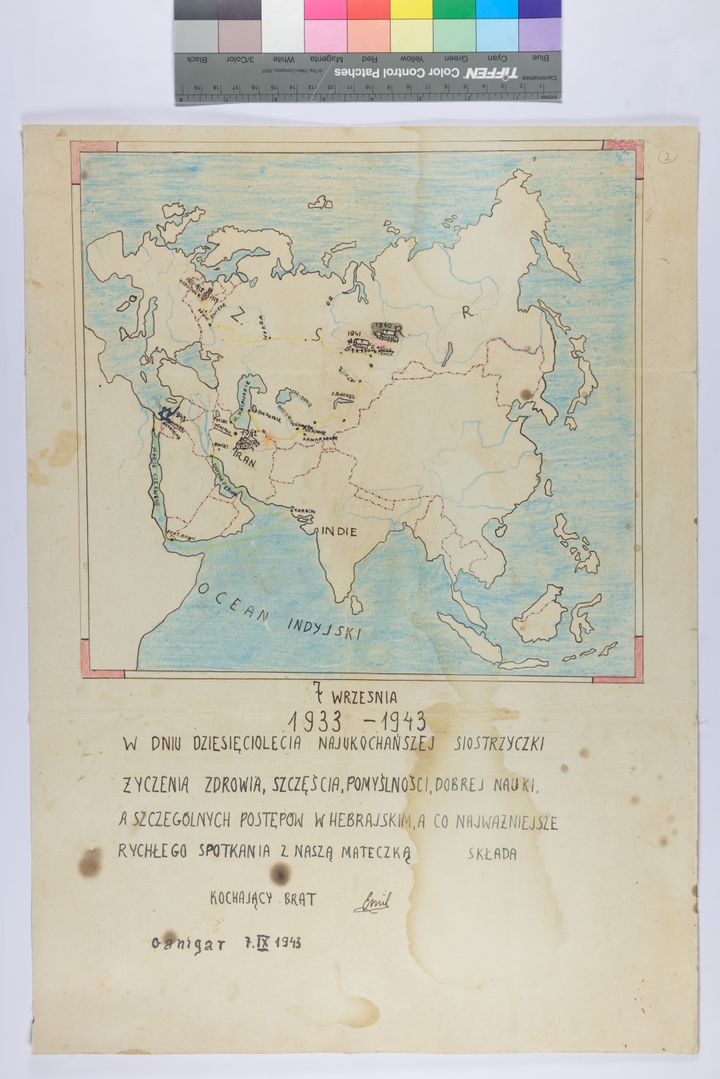
On 7 September 1943, sixteen-year-old Emil drew this map and wrote a dedication to his younger sister for her tenth birthday. The map illustrates their journey of flight and wanderings from Warsaw via Siberia, Uzbekistan and Tehran to Eretz Israel. The children‘s father was recruited to the Red Army and they parted from their mother when they joined the Tehran Children, and never saw her again. Emil was killed in Israel‘s War of Independence.
"I became a Zionist from the moment I felt that Zionism was providing my wounded nation… with an ideal that could embrace everything, irrespective of the different approaches."
Henrietta Szold
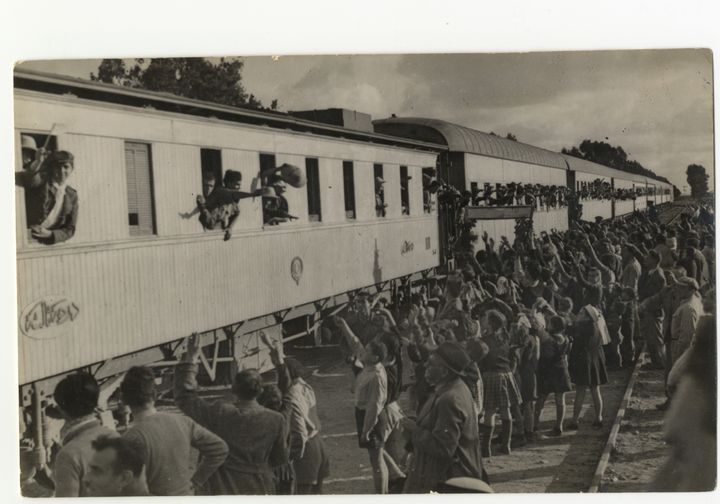
Crowds of people await the arrival of the Tehran Children at the railway station in Hadera, February 18, 1943.
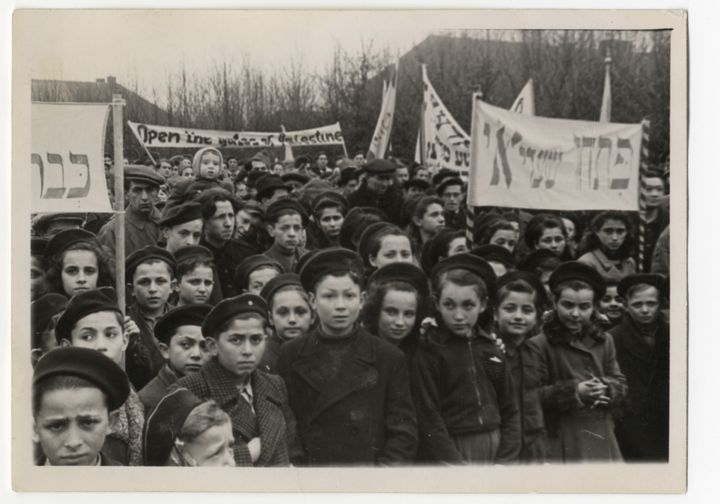
Assembly in support of free immigration to Eretz Israel, Eschwege DP Camp, Germany, March 24, 1947.
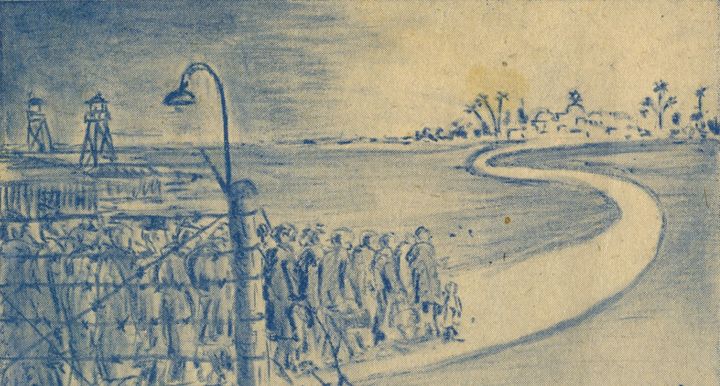
Rosh Hashanah (New Year’s) greetings card, “Next Year in Jerusalem!" from the Linz DP Camp, Austria
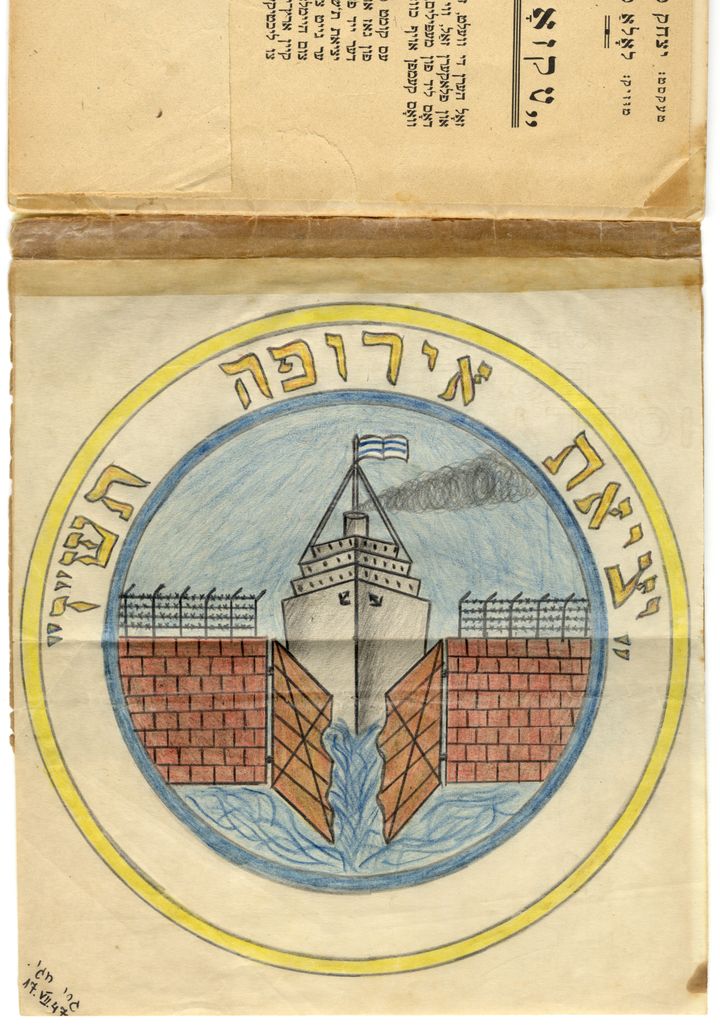
Painting by the youth Pesach Gregas (today Hagai Gari) in a workbook that he received in the Poppendorf camp after the return of the Exodus to Germany. "… I drew the ship breaking through the blockade to Eretz Israel… and wrote 'Exodus from Europe 1947,' which is the name of Exodus in Hebrew." From the testimony of Hagai Gari
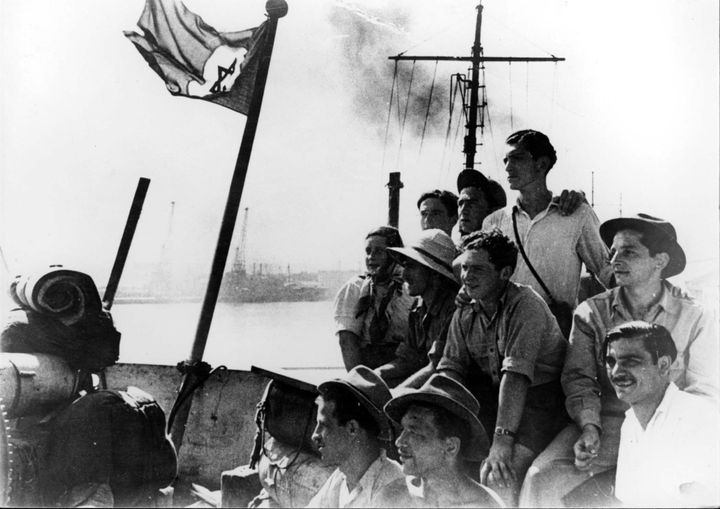
Nahum Bendel, Longing for the Land of Israel, Cyprus,1948, India ink and gouache on paper, 33.4X25.2 cm
Yad Vashem Art Collection, Gift of the artist
Nahum Bendel was born in 1928 in Kvasy, in theCarpathian Mountains of Czechoslovakia. In 1944, he was deported with his family to the Mestelka ghetto. They were then sent to Auschwitz, where his whole family was murdered. In April 1947, he boarded the illegal immigration ship the Theodore Herzl, but it was caught by the British just off the Tel Aviv coast and its passengers were deported to Cyprus. He finally arrived in Israel in 1948.
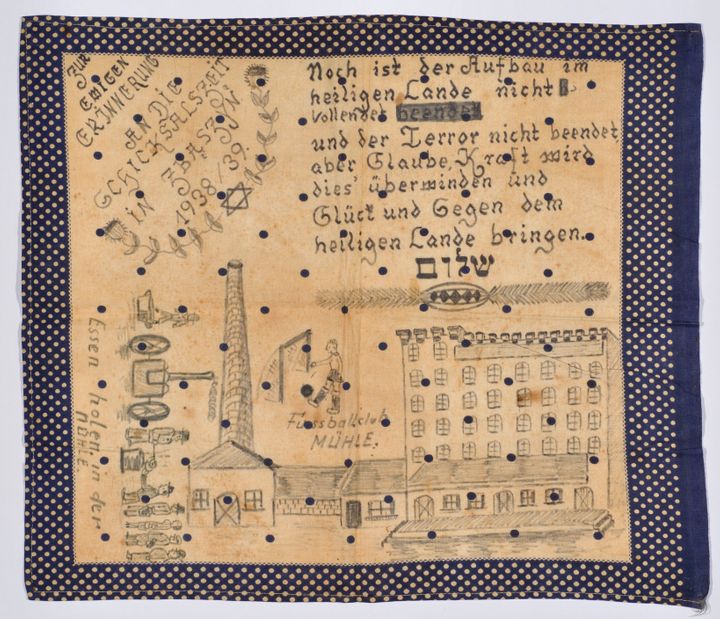
Napkin embroidered with pictures and inscriptions in German, expressing the feelings and emotions of Jews with Polish citizenship expelled from Germany to Zbaszyn, Poland. The napkins were distributed among the deportees who drew and wrote upon them, and kept them as mementos of the expulsion. On the top right portion of the napkin is a prominent inscription in German: “In the Holy Land construction has not been completed and the terror has not ended, but with the power of faith they will overcome this and bring a blessing to the Holy Land. Shalom. “Other drawings on the napkin show the fortified structure in which the deportees found shelter. Also appearing is a description of a distribution of soup from a huge steam-heated kettle. This napkin was preserved by Shlomo and Tova Laks and their son Manfred, who were among the deportees from Hanover to Zbaszyn. After staying about six months in Zbaszyn, the family managed to get permission to immigrate to Eretz Israel.
Yad Vashem Artifacts Collection
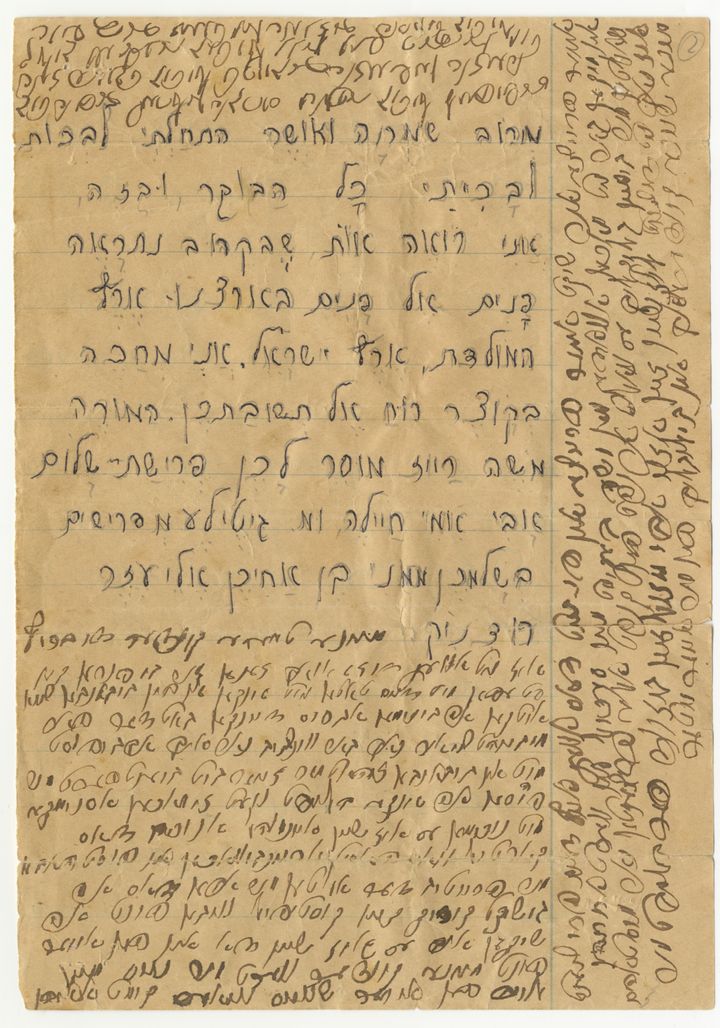
“I see a sign that we will meet each other face-to-face in our Land, our Homeland, Eretz Israel. “ Letter written in 1937 by ten-year-old Eliezer Rudnik to his aunts who had immigrated to Eretz Israel. The letter, written in Hebrew, is surrounded by rows of Yiddish that his parents wrote for lack of pages. Aryeh and Sarah Rudnik and their son Eliezer, the only Jews living in the Ukrainian village of Kosmaczow, were shot in 1942 at a killing pit after the German occupation.
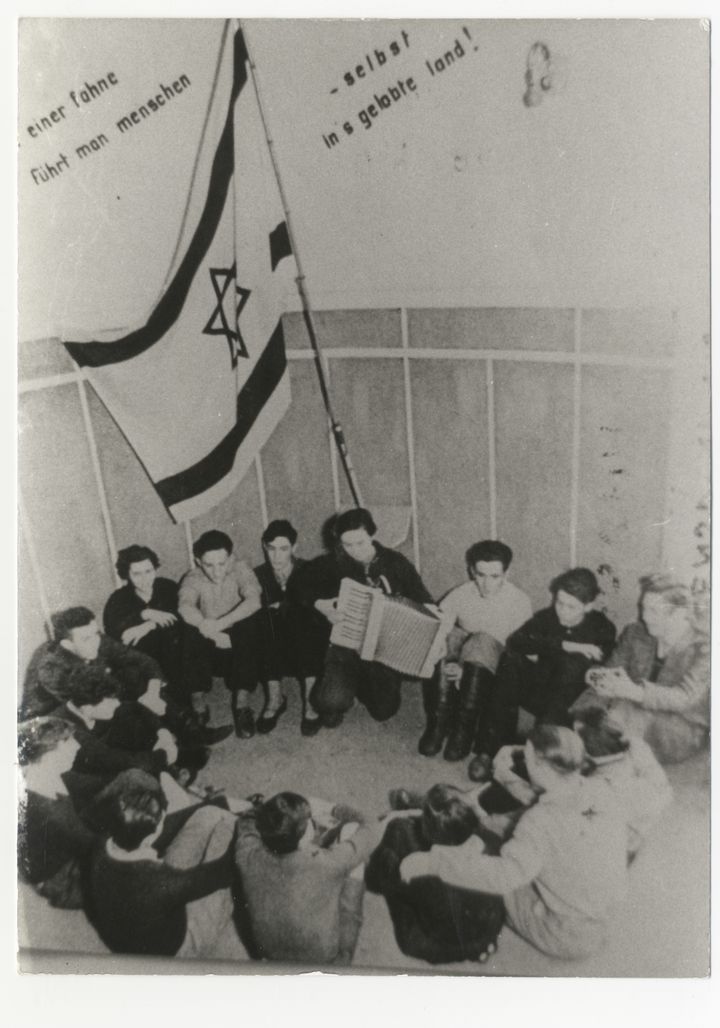
Community singing by young members of the Maccabi Youth Movement at their training farm in Ahrensdorf, Germany, before WWII (1938/1939).
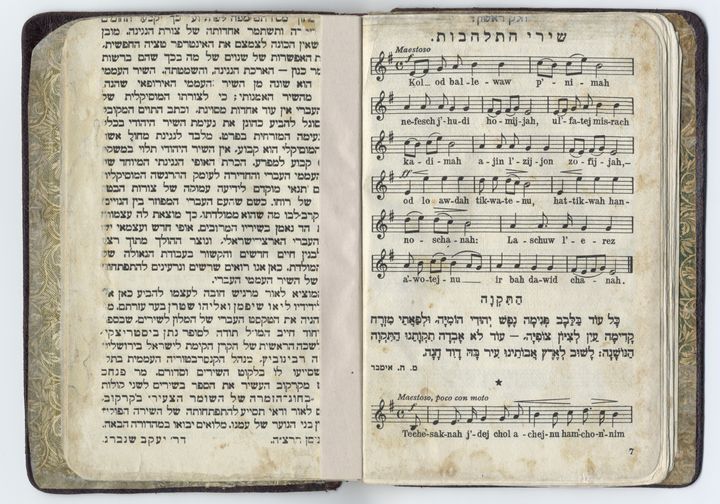
"Songs of Eretz Israel“ songbook, arranged by Yakov Schoenberg, 1935, Berlin. The songbook was collected from an attic in Theresienstadt during the first days of the liberation of ghetto by Yehiel Korentz and his son Avraham, survivors from Piotrków, Poland.
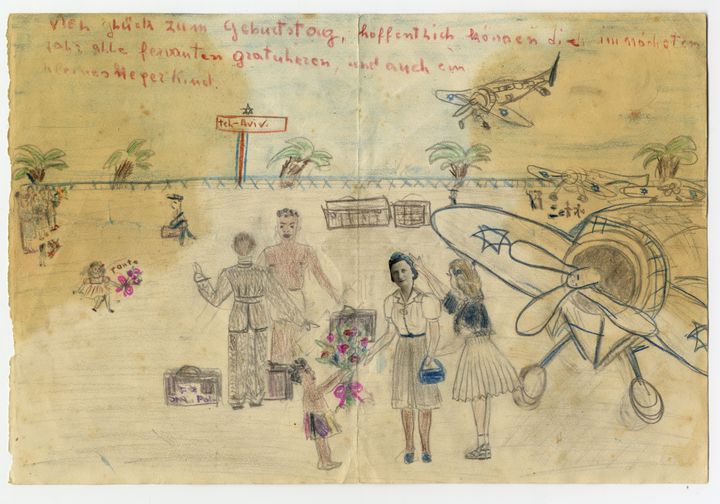
“My dream is to get to Eretz Israel“ — Drawing created by Hilda Regina Cimet for her mother‘s birthday influenced by the period the family spent in Benghazi, Libya, after they fled Germany on their way to Eretz Israel. The drawing expresses Regina‘s longing to arrive in the Holy Land with her family as soon as possible — “like the flight of a bird“ — in a plane, where her relatives, who had immigrated during the 1930s, would receive them. She imagines the airport in Tel Aviv with Israeli airline planes and a great crowd, among them natives of the land, coming to greet the family. The drawing took form as the family were forced to remain in Benghazi for months of uncertainty as to when they could sail for Eretz Israel. Five years would pass before the family arrived in Israel. Regina told about the period spent in the Benghazi jail.
Yad Vashem Artifacts Collection
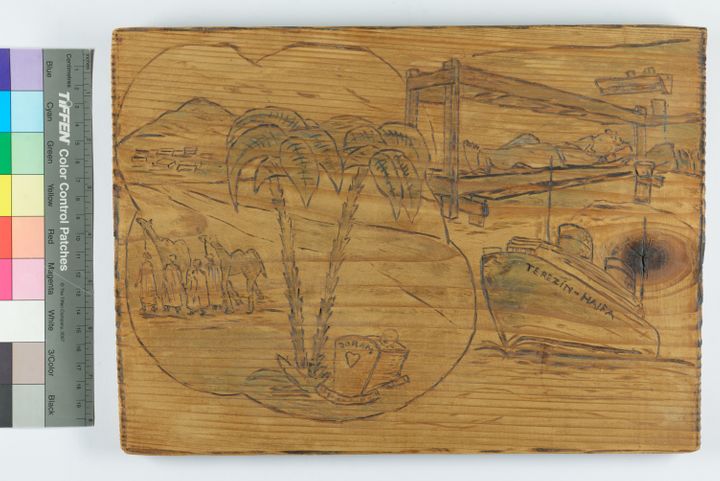
While he was imprisoned in the ghetto, Dr. Philip Herman received news from his daughter Esther who had immigrated to Eretz Israel. She had given birth to her first child, a son, and named him Yoram. Upon hearing the news, Dr. Herman wanted to prepare a present for his first grandson, and asked an artist in the ghetto to make an engraving that would express his dream to visit his daughter and grandson in Eretz Israel. His yearning to meet his loved ones was intensified both because of the great distance and due to his understanding that most probably he would never leave the ghetto. The wood engraving shows a man sleeping upon a bench and dreaming: a ship makes its way from Theresienstadt to Haifa, and Eretz Israel is represented through palms, camels and Bedouin figures. Under the palm tree is a baby in a cradle, and over it is the name of his grandson, Yoram. Dr. Herman never saw his grandson. He was sent with the last deportation from Theresienstadt to Auschwitz, where he was murdered.
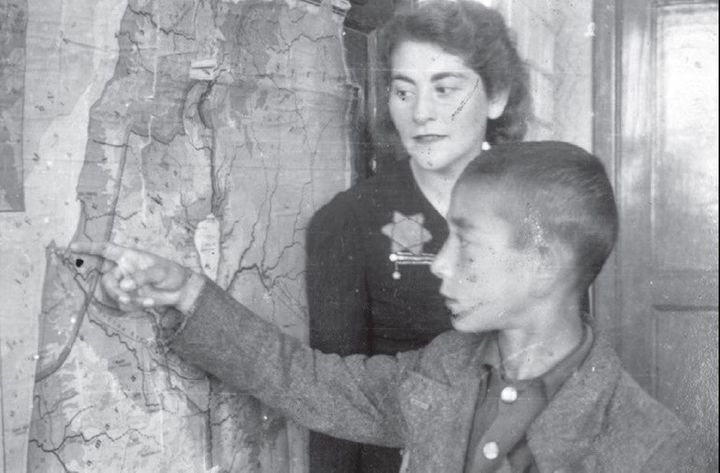
A teacher and a student near a map of Eretz Israel in the Łódź ghetto, Poland.