
Baltimore, MD - May 14, 2018 - As an Orthodox rabbi and as a politically-engaged American citizen, I deeply value the place that religion occupies in our body politic.
Our country’s founders, themselves men of great faith, thought to construct a system that would welcome the input of religion into political debate.
From coinage and bills that proclaim, “In God We Trust,” to the plaster reliefs of religious law givers, including Moses, Maimonides, and Pope Innocent III, that adorn the US House chamber, we celebrate the role that religion plays in our nation’s culture and legislative proceedings.
At the same time, our founders were strongly disinclined to replicate the model of national, state-sanctioned religion that was commonplace at the time of America’s founding. In his 1802 letter to the Danbury Baptist Association in Connecticut, Thomas Jefferson wrote:
"I contemplate with sovereign reverence that act of the whole American people which declared that their legislature should 'make no law respecting an establishment of religion, or prohibiting the free exercise thereof,' thus building a wall of separation between Church & State.”
A wall between church and state.
Our country’s government is disallowed to enshrine or discourage any specific set of religious beliefs. This directive also prevents religious litmus tests being applied to government officials and staff. Article VI of the United States Constitution explicitly states that "no religious Test shall ever be required as a Qualification to any Office or public Trust under the United States."
Ours is a system of nuance. Our government encourages religious influence in the political sphere, but it cannot condone one religious voice at the expense of another. Our Congress is free to hire a chaplain at public expense, but he or she cannot advance a specific faith’s dogma.
Last summer, I had the honor to serve as Guest Chaplain to the US House of Representatives. In that capacity, I offered opening prayers from the Speaker’s rostrum and met with various members of the House concerning the pressing issues of the day.
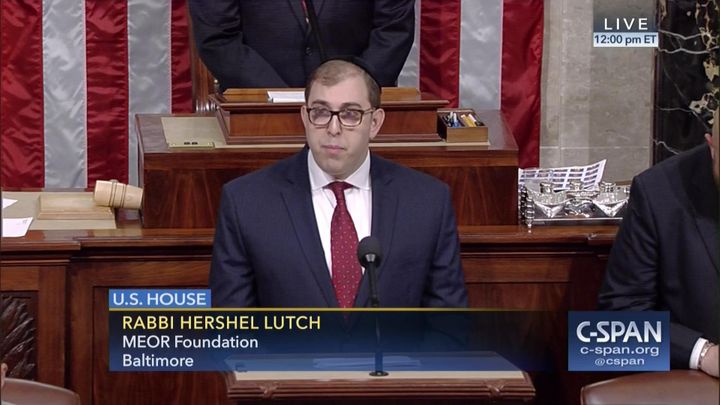
Rabbi Hershel Lutch serving as Guest Chaplain in the US House Chamber
How remarkable it is, I felt that day, that a rabbi should be asked to address a majority-Christian legislature. The active inclusion of Jewish clergy that is so commonplace in modern America is made all the more remarkable by its fundamental rarity throughout the Jewish people’s long history.
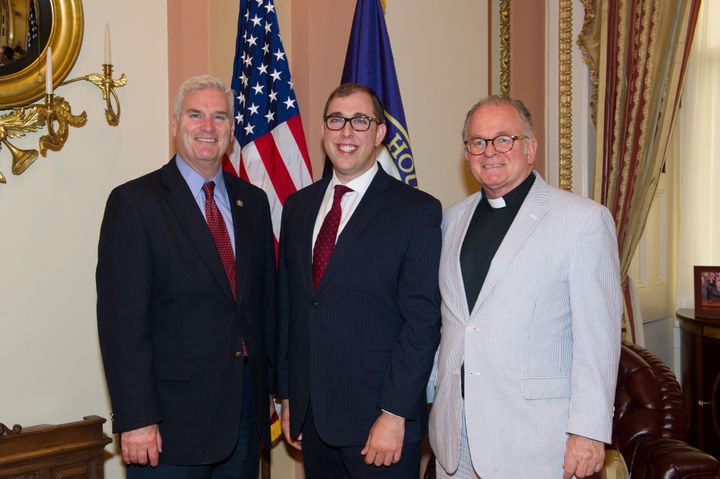
(L-R) Congressman Tom Emmer (R-MN), Rabbi Hershel Lutch, and Father Patrick Conroy in the Speaker's Lobby in the US Capitol.
I attended the house as Guest Chaplain at the invitation of Father Patrick J. Conroy, the Chaplain of the United States House of Representatives.
When I met him in the Speaker’s Lobby this past June, Father Conroy shared how proud he was to have a rabbi offer opening prayers. He told me that one of his goals as Chaplain was to introduce a broad representation of faith leaders to the House; true to his word, he has brought a diverse selection of guest chaplains to the House during his tenure as Chaplain.
Of course, Father Conroy has been in the news lately.
Last month, Speaker Paul Ryan asked for Father Conroy’s resignation. Then, seemingly under pressure, Speaker Ryan rescinded his request for Father Conroy’s removal.
I have no knowledge of the dismissal procedures of a US House Chaplain. Similarly, and in spite of the very generous treatment he afforded me this past June, I fully acknowledge that I cannot possibly offer a learned option about the overall performance of Father Conroy as Chaplain.
However, as details of the termination emerge, I grow increasingly concerned that religious bigotry may have factored into the decision to terminate Father Conroy.
The New York Times reported on May 3rd that, “When Mr. Ryan’s chief of staff, Jonathan Burks, informed him that the speaker was asking for his letter of resignation, Father Conroy wrote, “I inquired as to whether or not it was ‘for cause,’ and Mr. Burks mentioned dismissively something like, ‘Maybe it’s time that we had a chaplain that wasn’t a Catholic.’ ”
I was not there. I did not overhear the conversation. I do not know if Father Conroy’s recollections would match those of Mr. Burks. However, if Mr. Burks did indeed suggest that Father Conroy should be terminated because of his Catholicism, we should all be deeply concerned.
The speaker’s office owes Father Conroy, the House, and the American people either a clarification or an apology. The mere perception that faith leaders can be disqualified from their municipal offices based solely on the particulars of their faith undermines the great benefit that they can afford our political process.
~ ~ ~ ~ ~
Rabbi Hershel Lutch is an advocate for the American Jewish community and has served in leadership roles within several prominent Jewish organizations, including Aish HaTorah and the Orthodox Union.